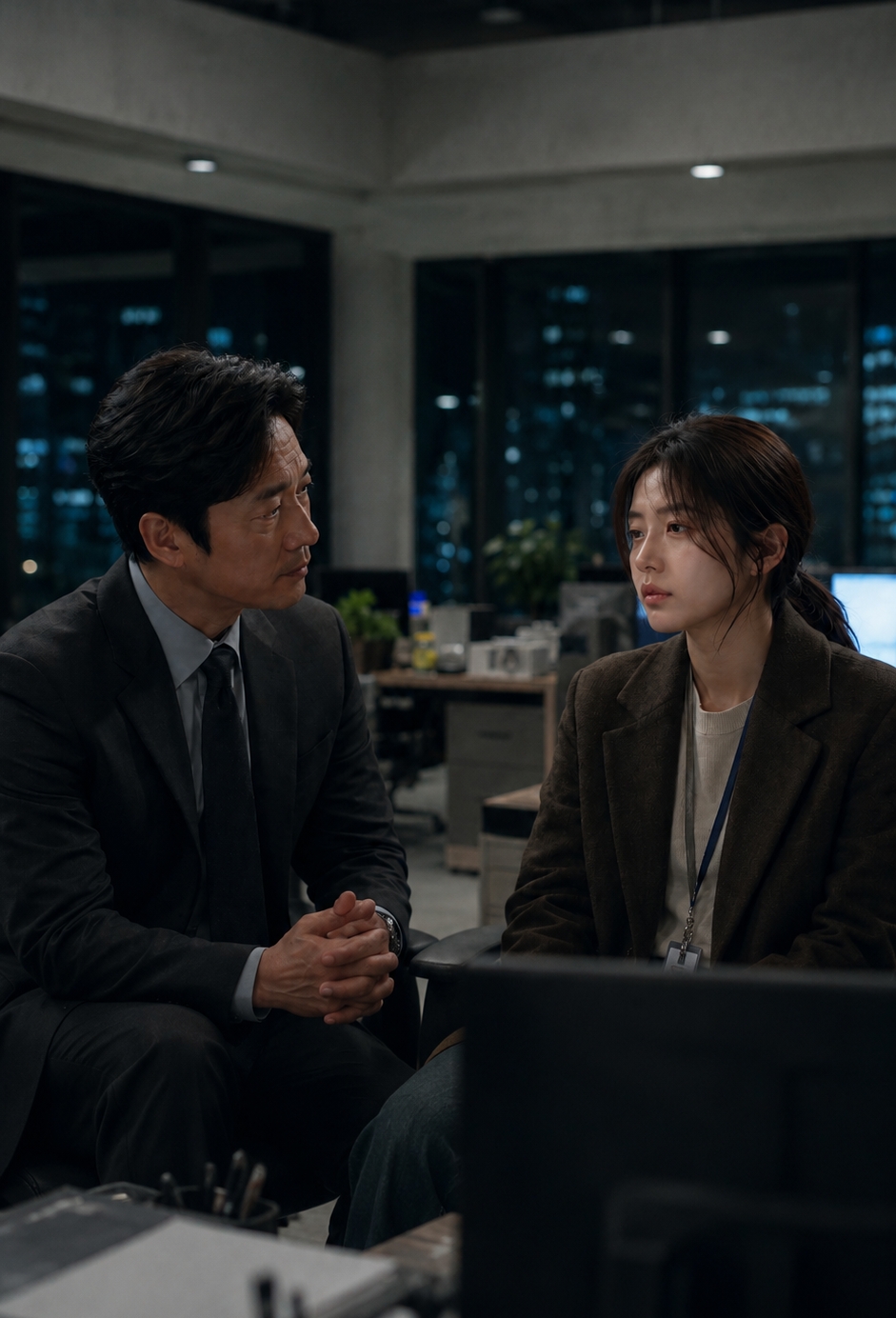
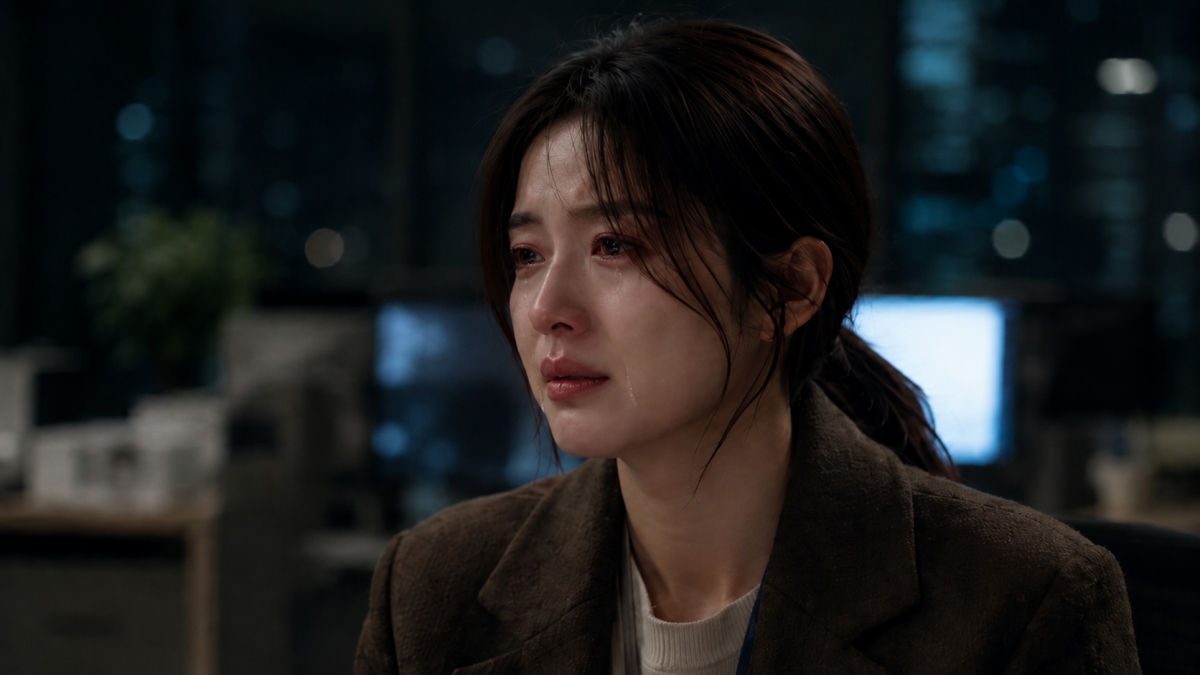
An ordinary evening inside the office, just before quitting time. Most desks have gone quiet, and the day is nearly over, but Yujin is still sitting at her desk as if she cannot bring herself to leave. Sangwoo notices and asks why she is still there. What begins as a small end-of-day exchange becomes a private moment of care, where the exhaustion she has been hiding is finally seen.
Close your eyes and listen
RoleplayChoose a role
Ready
OSTauto at emotional peak
Dialogue
SangwooGentle concern disguised as casual remark
...아직 안 갔어?
...ajik an gasseo?
...You haven't left yet?
YujinReflexive defense, startled to be noticed
아... 네. 조금만 더 앉아있으려고요.
a... ne. jogeumman deo anja-isseuryeogoyo.
Oh... yes. I was just going to sit a little longer.
SangwooWeary honesty, deliberate vulnerability
나도 집에 가기 싫은 날이 있어.
nado jibe gagi sireun nari isseo.
I have days when I don't want to go home either.
YujinGenuine surprise, guard slipping for a moment
SangwooThe quietest devastation, a statement not a question
너... 많이 힘들었지.
neo... mani himdeureotji.
You... it's been really hard, hasn't it.
SangwooPermission to break, his voice barely holding
괜찮아. 울어도 돼. 아무도 없으니까.
gwaenchana. ureodo dwae. amudo eopseunikka.
It's okay. You can cry. No one's here.
YujinComplete collapse, the gratitude of a survivor
...감사... 합니다. 진짜... 감사합니다.
...gamsa... hamnida. jinjja... gamsahamnida.
...Th...ank you. Truly... thank you.
...감사... 합니다. 진짜... 감사합니다.
...Th...ank you. Truly... thank you.
Silence. Only the sound remains.
Key Vocabulary
힘들다
himdeulda
to be hard, to struggle, to suffer · adjective · 힘들었지 = you had it hard (past + confirmation)
괜찮다
gwaenchanta
to be okay, it's alright · adjective · one of the most-used words in Korean
울다
ulda
to cry · verb · 울어도 돼 = it's okay to cry
사람
saram
person, human being · noun · 사람이니까 = because I'm human
앉다
anjda
to sit · verb · 앉아있으려고요 = I was going to sit (stay)
감사합니다
gamsahamnida
thank you (formal) · phrase · deeper than 고마워, carries weight and respect
Grammar Points
~었/았지 past tense + confirmation/empathy
"You (did something), right?" — confirming what you already sense, with emotional weight
많이 힘들었지.
You've had it hard. · Not a question — it's acknowledgment. He already knows the answer.
~어/아도 돼 permission
"It's okay to ~" / "You may ~" — giving permission for something the person is holding back
울어도 돼.
You can cry. / It's okay to cry. · 돼 = it's allowed, it's permitted
~(으)니까 reason/cause (spoken)
"Because ~" — giving a reason, often to reassure or justify
아무도 없으니까.
Because nobody's here. · He's removing her fear of being seen as weak
Cultural Note
힘들었지 vs. "Are you okay?"
In English, we ask "Are you okay?" — which puts the burden on the other person to respond, often forcing them to say "I'm fine." In Korean, 힘들었지 doesn't ask. It states. It says: "I already see you. I already know." This removes the need to explain, to justify, to perform. It's acknowledgment without interrogation.
The weight of 감사합니다
Yujin could say 고마워요 (casual thanks). Instead she uses 감사합니다 — the most formal, heaviest form of gratitude. This tells us: what he gave her isn't small. It's not "thanks for holding the door." It's "thank you for seeing me as a human being." The formality carries the depth of what she received.
Silence as dialogue
Notice how much of this scene is silence. In Korean emotional culture, 말 없이 옆에 있는 것 (being beside someone without words) is often more powerful than any comfort speech. Sang-woo doesn't say "it'll get better" or "you're strong." He just stays. In Korean, this is called 곁에 있다 — to be at someone's side. It's a verb. It's an action. It's enough.