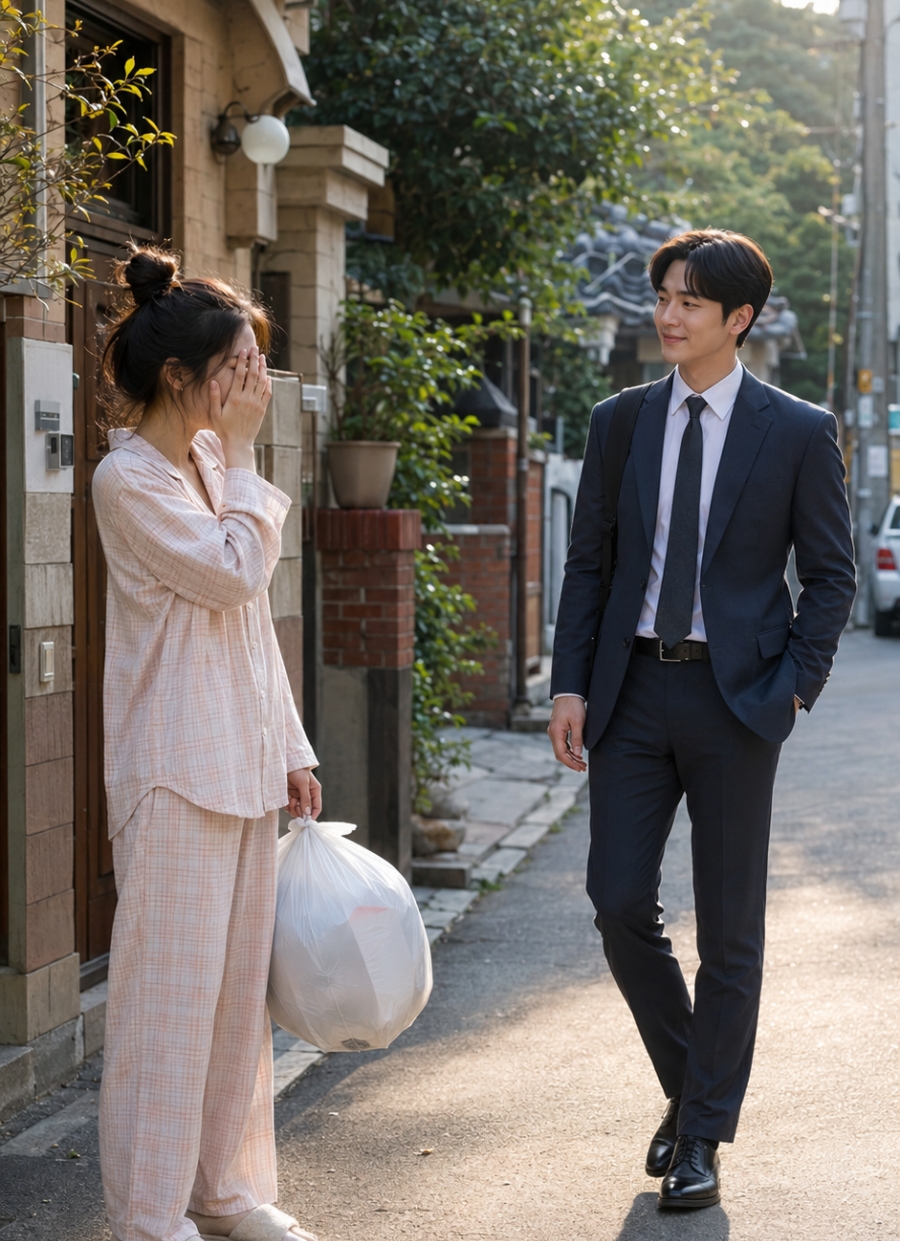
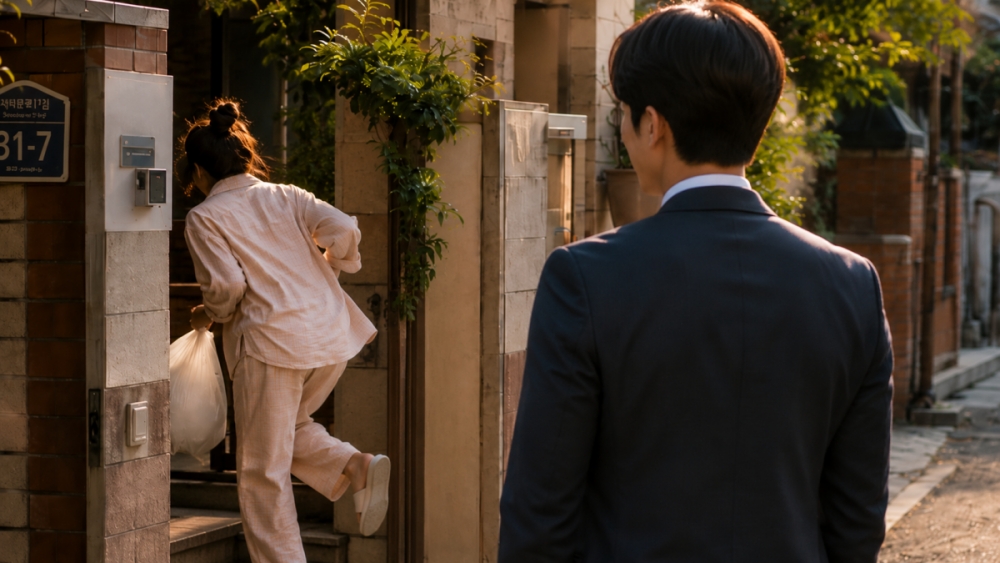
Early morning in a quiet residential alley, sunlight still soft on the pavement. Harin steps out in pajamas and slippers, hair messy and face bare, just to take out the trash — and walks straight into Junho, neatly dressed for work. She covers her face in horror, but he only slows down, smiling, refusing to look away. Six months of quiet glances between neighbors, and now the morning he finally decides to say one sentence more than usual.
Close your eyes and listen
RoleplayChoose a role
Ready
OSTauto at emotional peak
Dialogue
Junhowarm, pleased to see her
어, 일찍 나왔네?
Eo, iljjik nawanne?
Oh, you're up early.
Harinpanicked, embarrassed, covering face
오, 오지 마! 나 화장 안 했어.
O, oji ma! Na hwajang an haesseo.
D-don't come over! I don't have any makeup on.
Junhoteasing, amused softness
그래서 가리는 거야?
Geuraeseo garineun geoya?
Is that why you're hiding?
Harinshy, voice shrinking
당연하지… 보지 마.
Dangyeonhaji… boji ma.
Of course… don't look.
Junhogentle, sincere, stepping closer
그게 더 예쁜데, 왜 가려.
Geuge deo yeppeunde, wae garyeo.
You're prettier like that — why hide?
Harinheart racing, barely composed
…너 진짜 왜 그래?
…Neo jinjja wae geurae?
…What's gotten into you, really?
…너 진짜 왜 그래?
…What's gotten into you, really?
Silence. Only the sound remains.
Key Vocabulary
일찍
iljjik
Early; ahead of the expected time. Used to describe arriving or doing something sooner than planned.
화장
hwajang
Makeup. Refers to cosmetics or the act of putting on makeup.
가리다
garida
To cover, hide, or block from view. Often used when someone covers their face or body.
당연하지
dangyeonhaji
Of course; obviously. A casual reply showing something is so natural it doesn't need explaining.
예쁘다
yeppeuda
To be pretty or beautiful. Often used as a compliment, especially toward women or cute things.
진짜
jinjja
Really; seriously. Used to emphasize emotion or surprise, like 'come on' or 'seriously?' in English.
Grammar Points
-지 마 (negative command)
Attached to a verb stem to tell someone casually 'don't do it.' Used between close friends, family, or romantic partners. With strangers or elders, use -지 마세요.
오지 마!
Don't come (over here)!
-는 거야? (casual question with explanation nuance)
Used to ask 'is it that…?' or 'so you're doing…?' It softens a question and asks for the reason behind an action. Very common in casual speech.
그래서 가리는 거야?
So that's why you're covering (your face)?
-는데 (contrast/soft comment)
Ends a sentence to give a soft opinion or hint at a contrast, like 'but…' or 'though…' in English. It makes statements feel gentle, not pushy.
그게 더 예쁜데.
But that looks prettier (to me).
Cultural Note
In Korean dating culture, especially in K-dramas, the moment a woman is seen without makeup (생얼, saengeol) by her romantic interest is treated as a deeply intimate and vulnerable scene. Korean beauty standards place strong social pressure on women to appear 'put-together' in public, so being caught bare-faced by someone she likes feels exposing — almost more intimate than physical touch.
The male lead's response — '그게 더 예쁜데, 왜 가려' ('You look prettier that way, why hide?') — is a classic K-drama heart-flutter (심쿵, simkung) line. He isn't just complimenting her looks; he's signaling that he sees and accepts her real, unpolished self. This kind of soft, indirect affection is far more common in Korean romance than direct 'I love you' declarations.
Her flustered reply '너 진짜 왜 그래?' literally means 'Why are you really like this?', but emotionally it means 'Stop making my heart race!' It's a playful, embarrassed protest that actually signals she's deeply touched — a very Korean way of expressing love by pretending to push it away.
Mini Quiz
Q1
What does 하린 mean when she says '오지 마! 나 화장 안 했어'?
화장 안 했어 literally means 'I didn't put on makeup.' Combined with 오지 마 ('don't come'), she's flustered about being seen bare-faced, not actually angry.
Q2
What feeling is 준호 expressing when he softly says '그게 더 예쁜데, 왜 가려'?
The soft tone plus the -는데 ending makes it a gentle, heartfelt compliment. It's a classic K-drama 심쿵 (heart-flutter) line meant to show real affection, not teasing.
Q3
Why is being seen without makeup such a big emotional moment in this Korean drama scene?
Korean beauty norms make showing one's '생얼' to a crush feel deeply exposing. Accepting her natural face is a meaningful gesture of intimacy in K-drama romance.